
What Are the Safety Measures Taught in the Dachdecker Training in Germany?
Safety measures in Dachdecker training
Working as a Dachdecker (roofer) in Germany is considered one of the most skill-intensive, physically demanding, and safety-dependent professions. Roofers work at heights, deal with heavy materials, operate power tools, navigate steep slopes, and work in unpredictable weather. Because of these risks, Germany’s Dachdecker Ausbildung (roofing vocational training) places extremely high importance on safety education.
This blog explains all safety measures taught in the Dachdecker Ausbildung, covering equipment handling, fall-protection systems, firefighting basics, environmental safety, first aid, teamwork protocols, and much more.
If you’re planning to apply for a roofing apprenticeship in Germany, this guide will help you understand exactly what safety skills you will learn.
⭐ Introduction: Why Safety Is the Core of Roofer Training
Roofing is one of the oldest trades in Europe and continues to be in high demand. But it is also a profession where a simple mistake can cause serious injury. German law requires strict safety standards for all construction workers, especially roofers.
During the Dachdecker Ausbildung, trainees are taught:
- proper tool handling
- fall-protection techniques
- how to secure scaffolding
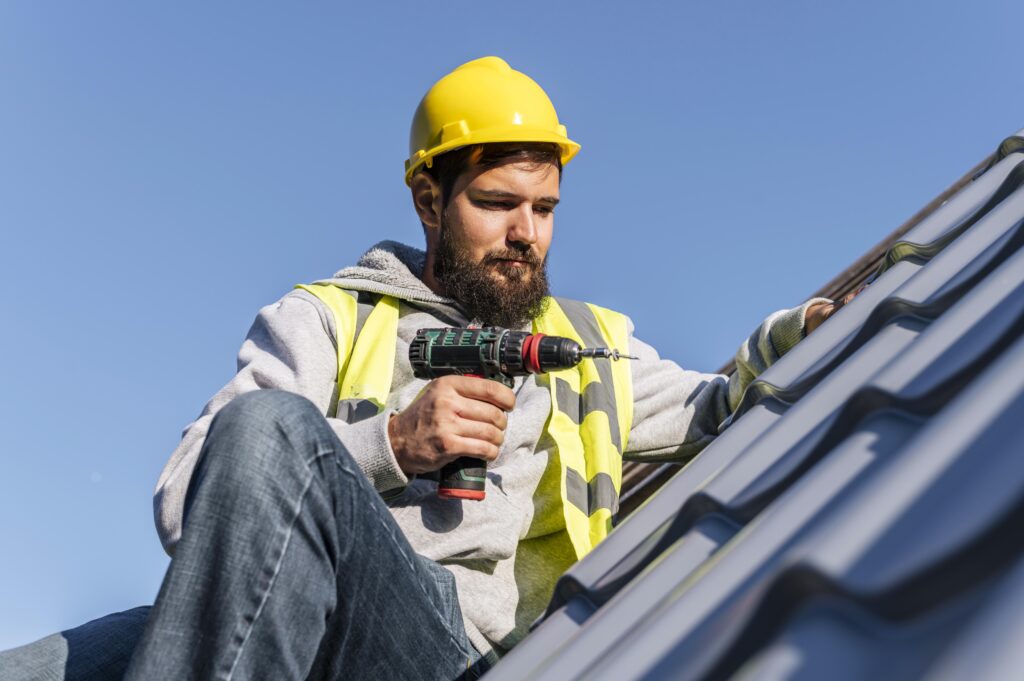
- use of PPE (personal protective equipment)
- compliance with German safety standards
- first aid and emergency responses
- fire safety and material handling
- teamwork communication on rooftops
Safety is not just a chapter; it is included in every module of the training. Trainees must follow safety rules on a daily basis, both during school lessons and practical company work.
1. Personal Protective Equipment (PPE): The Foundation of Roofer Safety
1.1 Importance of PPE in Roof Work
Roofing involves working at heights, dealing with sharp tools, cutting materials, and handling hot systems like bitumen. PPE reduces the risk of injuries significantly.
German Ausbilders (trainers) teach trainees to use PPE before they step on a roof.
1.2 Types of PPE Taught During Training
Trainees learn to correctly use and maintain:
✔ Safety helmets
Protects against falling objects (tiles, tools, debris).
✔ Anti-slip safety shoes
Important for maintaining grip on sloped roofs.
✔ Safety gloves
Used for handling nails, metal sheets, tiles, and hot materials.
✔ Protective glasses
Prevents injuries from cutting dust and flying particles.
✔ Hearing protection
Required when using loud power tools — drills, saws, nail guns.
✔ High-visibility vests and jackets
Makes workers easily visible, especially in fog or low-light.
✔ Fall-arrest harnesses
This is one of the most important tools in roofing safety. Trainees learn how to:
- wear a harness properly
- inspect it for damage
- attach it to anchor points
- check rope length and tension
Failing to secure a harness properly can result in fatal accidents, so trainees practice this repeatedly.
2. Fall-Protection Systems: Safety on Heights
Roofers spend most of their time working on tall structures. Hence, learning fall-protection systems is essential.
2.1 Types of Fall-Protection Systems Covered
Trainees learn about:
✔ Guard rails
Installed on flat roofs or construction sites to prevent falls.
✔ Safety nets
Used during new construction or when working on open edges.
✔ Anchor points
Fixed spots on roofs where harnesses can be attached.
✔ Rope systems / Lifelines
Allow safe movement across sloped areas.
✔ Scaffolding safety
Rooftop scaffolds must be secured tightly and inspected daily.
2.2 Training in Roof Navigation
Trainees are taught how to:
- walk safely on pitched roofs
- balance weight while carrying tools
- identify weak spots on old roofs
- avoid slippery areas (moss, moisture, frost)
This is practiced repeatedly during real work assignments.
3. Ladder Safety and Proper Positioning
Ladders are used daily by roofers. Incorrect ladder handling causes many workplace injuries.
In the training, students learn:
✔ Correct ladder angle (75° rule)
The ladder must lean against the structure at a safe angle.
✔ Secure foot placement
Both ends of the ladder must be on stable ground.
✔ Tying the ladder
Prevents slipping and crossing over during work.
✔ Three-point contact rule
While climbing, the worker must maintain contact through two feet and one hand, or two hands and one foot.
✔ Choosing the right ladder type
Extension ladders, step ladders, and roof ladders are used for different tasks. Trainees learn which one suits a specific roof slope.
4. Scaffolding Safety Measures
Working on scaffolding is part of every roofing project.
Trainees are taught to:
- check scaffolding load capacity
- inspect for loose or missing planks
- ensure guard rails are installed
- avoid overloading one side
- report any unstable or damaged parts
They also learn how to climb scaffolds safely using designated entry points rather than random openings.
5. Weather-Related Safety Precautions
Weather plays a major role in roofing work. Trainees learn to assess roof safety according to environmental conditions.
5.1 Unsafe Weather Conditions
Trainees must stop work during:
- heavy rain
- storms and strong winds
- snow or frost
- extreme heat
- lightning and thunderstorms
5.2 Heat and UV Protection
Training includes:
- staying hydrated
- using sunscreen
- taking breaks in shade
- wearing UV-resistant workwear
5.3 Winter Safety Training
Winter roofing is particularly dangerous. Apprentices learn how to:
- identify frost-covered roof areas
- remove snow before work
- use special roof shoes
- avoid icy surfaces
6. Safe Handling of Tools and Roofing Materials
Roofers use a combination of hand tools and advanced machines. Incorrect handling can cause serious accidents.
6.1 Hand Tools Taught in Training
Trainees practice the safe use of:
- roofing hammers
- utility knives
- chisels
- nail tools
- measuring tools
- tile cutting tools
They are taught to always maintain tool sharpness and inspect for defects.
6.2 Power Tools
Trainees learn to safely operate:
- drills
- cutting machines
- hot-air blowers
- angle grinders
- circular saws
- electric nail guns
Important lessons include:
- safe switching on/off
- maintaining distance from cables
- keeping tools dry
- avoiding overheating
6.3 Material Handling Safety
Roof materials such as tiles, shingles, metal sheets, and bitumen rolls are heavy and sharp.
Training includes:
- proper lifting posture
- team lifting for heavy objects
- storing materials safely on roofs
- avoiding tile breakage
- preventing falling debris
7. Hot Work Safety: Bitumen, Heat Guns & Fire Hazards
Roofers often work with hot bitumen for waterproofing systems. This involves fire and burn risks.
Trainees learn:
✔ Controlled heating of bitumen
Too much heat causes boiling and explosion risks.
✔ Use of gas burners
Gas cylinders must be installed upright and leak-tested before use.
✔ Fire extinguishing measures
Every site must have:
- fire extinguishers
- fire blankets
- sand buckets
✔ Emergency fire response
Trainees are taught how to react immediately if:
- bitumen catches fire
- gas leaks
- sparks hit flammable materials
8. First Aid Training: Essential for All Roofing Trainees
Every Dachdecker trainee must complete basic first aid training as part of the Ausbildung.
They learn:
- treating cuts and wounds
- stopping bleeding
- dealing with burns
- recognizing heat stroke or dizziness
- stabilizing a worker after fall trauma
- CPR (Cardiopulmonary Resuscitation)
- using first aid kits correctly
Companies often assign a trainee as a safety marshal during projects.
9. Team Communication and Coordination on Roofs
Roof work is always a team effort. Miscommunication can cause accidents.
Trainees learn:
✔ Communication signals
Hand signals and verbal cues for moving materials.
✔ Cooperative lifting
Two or more people lifting heavy components.
✔ Tool passing etiquette
Never throw tools. Always pass securely.
✔ Position awareness
Workers must know where teammates are positioned at all times.
✔ Shared safety responsibility
If one person notices a safety issue, the entire team must stop work until it’s fixed.
10. Hazard Identification and Risk Assessment
Before beginning roof work, trainees are taught to inspect:
- loose tiles
- unstable roof beams
- water-damaged sections
- weak edges
- old chimneys
- electrical wires
- insect nests (bees, wasps)
They document risks and discuss them with supervisors before starting any task.
11. Environmental Protection and Waste Management Safety
Roofers dispose of old materials such as asbestos, metal, tiles, and bitumen. Handling waste requires safety knowledge.
Trainees learn:
- separating recyclable and hazardous waste
- avoiding inhalation of dust
- using protective masks
- storing chemicals safely
- preventing contamination of water and soil
Germany has strict environmental laws, and roofers must follow them carefully.
12. Legal Safety Requirements in Germany (DGUV Rules)
During the Ausbildung, trainees study German safety standards enforced by:
- DGUV (German Statutory Accident Insurance)
- BG BAU (Construction Industry Safety Board)
- ArbSchG (Occupational Safety Act)
They learn:
- mandatory safety protocols
- documentation procedures
- employer responsibilities
- worker responsibilities
- accident reporting
13. Emergency Procedures and Rescue Training
Roofers must know how to act instantly if something goes wrong.
Training includes:
✔ Rescue techniques for workers who fall
Harnesses can cause circulation problems if a worker hangs too long.
✔ Evacuation during storms or fire
✔ Using emergency ladders and ropes
✔ Calling emergency services (112)
✔ Securing the roof before leaving
Conclusion: Safety Training Makes German Roofers Highly Skilled
The Dachdecker Ausbildung in Germany is not just about learning roofing techniques—it deeply focuses on safety, risk management, and professional responsibility. Every trainee becomes an expert in:
- fall protection
- tool safety
- fire prevention
- emergency response
- teamwork
- weather analysis
- material handling
Because of such strict training, German roofing apprentices develop a high level of discipline and competence, making them some of the best-trained roofers in Europe.
If you’re planning to start the Dachdecker Ausbildung, be prepared to follow safety rules strictly. They are not just formalities—they protect your life and the lives of your teammates.
Roofing is one of the oldest trades in Europe and continues to be in high demand. But it is also a profession where a simple mistake can cause serious injury. German law requires strict safety standards for all construction workers, especially roofers.
During the Dachdecker Ausbildung, trainees are taught:
- proper tool handling
- fall-protection techniques
- how to secure scaffolding
- use of PPE (personal protective equipment)
- compliance with German safety standards
- first aid and emergency responses
- fire safety and material handling
- teamwork communication on rooftops
Safety is not just a chapter; it is included in every module of the training. Trainees must follow safety rules on a daily basis, both during school lessons and practical company work.
1. Personal Protective Equipment (PPE): The Foundation of Roofer Safety
1.1 Importance of PPE in Roof Work
Roofing involves working at heights, dealing with sharp tools, cutting materials, and handling hot systems like bitumen. PPE reduces the risk of injuries significantly.
German Ausbilders (trainers) teach trainees to use PPE before they step on a roof.
1.2 Types of PPE Taught During Training
Trainees learn to correctly use and maintain:
✔ Safety helmets
Protects against falling objects (tiles, tools, debris).
✔ Anti-slip safety shoes
Important for maintaining grip on sloped roofs.
✔ Safety gloves
Used for handling nails, metal sheets, tiles, and hot materials.
✔ Protective glasses
Prevents injuries from cutting dust and flying particles.
✔ Hearing protection
Required when using loud power tools — drills, saws, nail guns.
✔ High-visibility vests and jackets
Makes workers easily visible, especially in fog or low-light.
✔ Fall-arrest harnesses
This is one of the most important tools in roofing safety. Trainees learn how to:
- wear a harness properly
- inspect it for damage
- attach it to anchor points
- check rope length and tension
Failing to secure a harness properly can result in fatal accidents, so trainees practice this repeatedly.
2. Fall-Protection Systems: Safety on Heights
Roofers spend most of their time working on tall structures. Hence, learning fall-protection systems is essential.
2.1 Types of Fall-Protection Systems Covered
Trainees learn about:
✔ Guard rails
Installed on flat roofs or construction sites to prevent falls.
✔ Safety nets
Used during new construction or when working on open edges.
✔ Anchor points
Fixed spots on roofs where harnesses can be attached.
✔ Rope systems / Lifelines
Allow safe movement across sloped areas.
✔ Scaffolding safety
Rooftop scaffolds must be secured tightly and inspected daily.
2.2 Training in Roof Navigation
Trainees are taught how to:
- walk safely on pitched roofs
- balance weight while carrying tools
- identify weak spots on old roofs
- avoid slippery areas (moss, moisture, frost)
This is practiced repeatedly during real work assignments.
3. Ladder Safety and Proper Positioning
Ladders are used daily by roofers. Incorrect ladder handling causes many workplace injuries.
In the training, students learn:
✔ Correct ladder angle (75° rule)
The ladder must lean against the structure at a safe angle.
✔ Secure foot placement
Both ends of the ladder must be on stable ground.
✔ Tying the ladder
Prevents slipping and crossing over during work.
✔ Three-point contact rule
While climbing, the worker must maintain contact through two feet and one hand, or two hands and one foot.
✔ Choosing the right ladder type
Extension ladders, step ladders, and roof ladders are used for different tasks. Trainees learn which one suits a specific roof slope.
4. Scaffolding Safety Measures
Working on scaffolding is part of every roofing project.
Trainees are taught to:
- check scaffolding load capacity
- inspect for loose or missing planks
- ensure guard rails are installed
- avoid overloading one side
- report any unstable or damaged parts
They also learn how to climb scaffolds safely using designated entry points rather than random openings.
5. Weather-Related Safety Precautions
Weather plays a major role in roofing work. Trainees learn to assess roof safety according to environmental conditions.
5.1 Unsafe Weather Conditions
Trainees must stop work during:
- heavy rain
- storms and strong winds
- snow or frost
- extreme heat
- lightning and thunderstorms
5.2 Heat and UV Protection
Training includes:
- staying hydrated
- using sunscreen
- taking breaks in shade
- wearing UV-resistant workwear
5.3 Winter Safety Training
Winter roofing is particularly dangerous. Apprentices learn how to:
- identify frost-covered roof areas
- remove snow before work
- use special roof shoes
- avoid icy surfaces
6. Safe Handling of Tools and Roofing Materials
Roofers use a combination of hand tools and advanced machines. Incorrect handling can cause serious accidents.
6.1 Hand Tools Taught in Training
Trainees practice the safe use of:
- roofing hammers
- utility knives
- chisels
- nail tools
- measuring tools
- tile cutting tools
They are taught to always maintain tool sharpness and inspect for defects.
6.2 Power Tools
Trainees learn to safely operate:
- drills
- cutting machines
- hot-air blowers
- angle grinders
- circular saws
- electric nail guns
Important lessons include:
- safe switching on/off
- maintaining distance from cables
- keeping tools dry
- avoiding overheating
6.3 Material Handling Safety
Roof materials such as tiles, shingles, metal sheets, and bitumen rolls are heavy and sharp.
Training includes:
- proper lifting posture
- team lifting for heavy objects
- storing materials safely on roofs
- avoiding tile breakage
- preventing falling debris
7. Hot Work Safety: Bitumen, Heat Guns & Fire Hazards
Roofers often work with hot bitumen for waterproofing systems. This involves fire and burn risks.
Trainees learn:
✔ Controlled heating of bitumen
Too much heat causes boiling and explosion risks.
✔ Use of gas burners
Gas cylinders must be installed upright and leak-tested before use.
✔ Fire extinguishing measures
Every site must have:
- fire extinguishers
- fire blankets
- sand buckets
✔ Emergency fire response
Trainees are taught how to react immediately if:
- bitumen catches fire
- gas leaks
- sparks hit flammable materials
8. First Aid Training: Essential for All Roofing Trainees
Every Dachdecker trainee must complete basic first aid training as part of the Ausbildung.
They learn:
- treating cuts and wounds
- stopping bleeding
- dealing with burns
- recognizing heat stroke or dizziness
- stabilizing a worker after fall trauma
- CPR (Cardiopulmonary Resuscitation)
- using first aid kits correctly
Companies often assign a trainee as a safety marshal during projects.
9. Team Communication and Coordination on Roofs
Roof work is always a team effort. Miscommunication can cause accidents.
Trainees learn:
✔ Communication signals
Hand signals and verbal cues for moving materials.
✔ Cooperative lifting
Two or more people lifting heavy components.
✔ Tool passing etiquette
Never throw tools. Always pass securely.
✔ Position awareness
Workers must know where teammates are positioned at all times.
✔ Shared safety responsibility
If one person notices a safety issue, the entire team must stop work until it’s fixed.
10. Hazard Identification and Risk Assessment
Before beginning roof work, trainees are taught to inspect:
- loose tiles
- unstable roof beams
- water-damaged sections
- weak edges
- old chimneys
- electrical wires
- insect nests (bees, wasps)
They document risks and discuss them with supervisors before starting any task.
11. Environmental Protection and Waste Management Safety
Roofers dispose of old materials such as asbestos, metal, tiles, and bitumen. Handling waste requires safety knowledge.
Trainees learn:
- separating recyclable and hazardous waste
- avoiding inhalation of dust
- using protective masks
- storing chemicals safely
- preventing contamination of water and soil
Germany has strict environmental laws, and roofers must follow them carefully.
12. Legal Safety Requirements in Germany (DGUV Rules)
During the Ausbildung, trainees study German safety standards enforced by:
- DGUV (German Statutory Accident Insurance)
- BG BAU (Construction Industry Safety Board)
- ArbSchG (Occupational Safety Act)
They learn:
- mandatory safety protocols
- documentation procedures
- employer responsibilities
- worker responsibilities
- accident reporting
13. Emergency Procedures and Rescue Training
Roofers must know how to act instantly if something goes wrong.
Training includes:
✔ Rescue techniques for workers who fall
Harnesses can cause circulation problems if a worker hangs too long.
✔ Evacuation during storms or fire
✔ Using emergency ladders and ropes
✔ Calling emergency services (112)
✔ Securing the roof before leaving
Conclusion: Safety Training Makes German Roofers Highly Skilled
The Dachdecker Ausbildung in Germany is not just about learning roofing techniques—it deeply focuses on safety, risk management, and professional responsibility. Every trainee becomes an expert in:
- fall protection
- tool safety
- fire prevention
- emergency response
- teamwork
- weather analysis
- material handling
Because of such strict training, German roofing apprentices develop a high level of discipline and competence, making them some of the best-trained roofers in Europe.
If you’re planning to start the Dachdecker Ausbildung, be prepared to follow safety rules strictly. They are not just formalities—they protect your life and the lives of your teammates.
For official details about vocational training regulations and wages, you can visit the Federal Employment Agency’s Ausbildung Portal or the Make It In Germany website.